
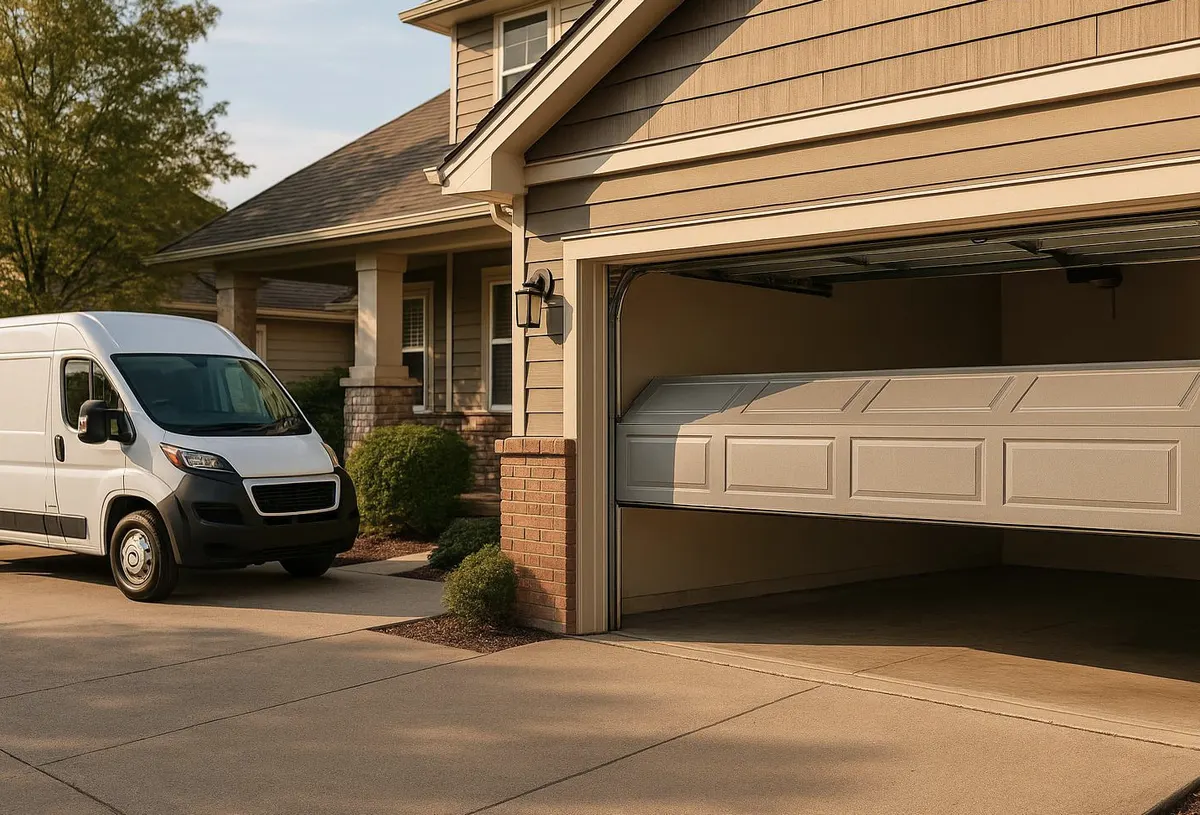
You're pulling into the driveway after an afternoon downpour, hit the remote, and the door groans and shudders its way up the track instead of gliding. Or maybe it's a sharp metallic squeak every time someone leaves for work in the morning. Either way, you've just noticed what a lot of Greenacres homeowners eventually notice: garage door hardware doesn't hold lubrication the way it does in drier climates, and skipping maintenance shows up fast.
Between the humidity, the salt carried in on the breeze, and the summer storm cycle, metal rollers, hinges, and springs here corrode and dry out quicker than manufacturer manuals (written for a national audience) usually assume. A regular lubrication routine is one of the cheapest ways to keep your door quiet, smooth, and off a technician's emergency schedule.
Tools and Products You'll Need
- White lithium grease or a silicone-based garage door lubricant spray (sold specifically for garage doors)
- A clean, lint-free rag
- A soft-bristle brush or old toothbrush
- Household cleaner or mild degreaser for grime buildup
- Step stool or ladder
- Work gloves and safety glasses
What to Avoid
- WD-40 — it's a solvent, not a lubricant. It displaces moisture short-term but evaporates quickly and leaves parts drier than before, which is a problem in a climate this humid.
- Standard motor oil or axle grease — too thick, drips onto the driveway, and attracts dust and pollen that turns into grinding paste.
- Petroleum jelly — breaks down too fast under heat and doesn't hold up outdoors.
Step-by-Step: How to Lubricate Your Garage Door
- Disconnect the opener. Pull the manual release cord so the door is operating on its springs alone, and unplug the opener unit if it's accessible. This keeps the door from engaging while you're working near moving parts.
- Inspect before you lubricate. Run your hand along each hinge, roller, and the torsion spring. Look for rust streaks, flaking metal, frayed cable strands, or a roller that wobbles instead of spinning cleanly. Note anything that looks bent or cracked — don't lubricate over damage, flag it for a technician instead.
- Clean each part first. Wipe away old grease, dirt, and any rust residue with a rag. A toothbrush works well for hinge pins and roller stems where grime builds up in the corners.
- Lubricate the hinges. Apply a light coat of white lithium grease or silicone spray to each hinge pivot point, working the door up and down a few times by hand to let it work into the joint.
- Lubricate the rollers. If you have steel rollers with ball bearings, apply lubricant to the bearing area, not the wheel surface itself. Nylon rollers (common on quieter, newer doors) usually don't need lubrication at the roller itself — just the stem.
- Give the springs a light coat. A thin film of lubricant along the torsion spring coils reduces friction and rust. Don't saturate it, and don't touch the spring's mounting hardware or attempt any adjustment.
- Leave the tracks alone. Tracks should be cleaned with a damp rag, never lubricated. Grease on the track attracts dirt and can actually cause the rollers to slip.
- Check the weatherstripping and seals. Wipe rubber seals with a silicone protectant to prevent them from drying out and cracking in the heat, which lets humidity and pests into the garage.
- Test the door. Reconnect the opener and run the door through a few full cycles, listening for any remaining noise and watching for smooth, even movement on both sides.
- Wipe off excess. Any lubricant left on the surface will just collect dust. A quick final wipe-down keeps things clean.
What's Safe for a Homeowner vs. What Needs a Technician
Lubricating hinges, rollers, and lock mechanisms, and wiping down weatherstripping, are all reasonable DIY tasks with basic tools. What's not a DIY job: adjusting or replacing a torsion spring, which is under extreme tension and can cause serious injury; straightening a bent track; replacing frayed cables; or diagnosing an opener that's cycling but not actually lifting the door. If you notice the door is heavier on one side, slams down instead of lowering smoothly, or a cable looks like it's unwinding, stop and call a technician rather than troubleshooting further.
When to Call Precision Garage Door of Greenacres
If lubrication doesn't quiet things down, or you're finding rust on hardware every few months because of salt air or storm humidity, it's worth scheduling a Garage Door Tune-Up & Maintenance visit. Our technicians check spring tension and balance, inspect cables and hardware for wind-load readiness ahead of storm season, and handle Cable & Roller Replacement when parts are too worn to save with grease alone. We'll tell you plainly what's routine upkeep and what's a safety issue, no upselling.
If your garage door in Greenacres, Lake Worth Beach, Wellington, or anywhere nearby is squeaking, sticking, or showing rust you can't get ahead of, give Precision Garage Door of Greenacres a call and we'll get it running smoothly again.